

Key Takeaways
- Remote work can lower overhead, expand your hiring pool, and improve flexibility. But it can also create multi-state tax and payroll compliance issues.
- In-person work can improve training, supervision, and team cohesion, but it often comes with higher fixed costs and less hiring flexibility.
- The best model depends on the kind of structure your team needs and whether the financial upside outweighs the compliance burden.
- Before you choose, run the numbers on the fully loaded cost per employee, not just salary, and make sure you understand the tax and regulatory consequences.
The great migration back to the office isn’t just the trend of larger employers anymore.
The number of fully in-person new businesses started in 2024 grew from 61% to 66%.
And yet, 98% of workers say they’d like to work remotely.
So, which setup is right for your Kansas City business, in terms of financial ROI and productivity? Let’s walk through the pros and cons of each.
What are the advantages of remote work for your small business?
Remote work can reduce overhead, expand access to talent, and increase flexibility, which can translate into a real financial advantage.
1. Lower overhead
When you reduce or eliminate office space, you’re cutting a long list of costs, including:
- Utilities
- Office internet
- Furniture and workstation setup
- Cleaning
- Office insurance
- Coffee, snacks, and supplies
- Maintenance and miscellaneous occupancy costs
For a small business, shaving those fixed costs can give you more financial breathing room and make your business less brittle during slow periods.
2. A wider talent pool
Once you are no longer hiring only within commuting distance, you can hire specialized talent faster and recruit from lower-cost labor markets. You can also create flexibility for employees with caregiving, disability, or relocation constraints.
3. Better productivity for certain kinds of work
If output depends more on concentration than on live interaction, remote work may increase productivity. Especially for areas like bookkeeping, design, writing, software development, technical analysis, or project-based client work, just to name a few examples.
4. Stronger recruiting and retention
Many workers consider remote work a benefit when looking for a job. Offering remote or flexible work may help you reduce turnover and fill open roles faster.
What are the downsides of remote work for a small business?
Remote work can weaken training, reduce informal communication, create security risks, and trigger multi-state compliance obligations.
1. More distractions
Some people have children, roommates, or space limitations that make working from home difficult.
2. Blurred work-life boundaries
Without a physical transition out of the office, some employees struggle to shut work off. That can create burnout, resentment, or simply lower-quality work over time.
3. Harder training and culture transfer
In person, employees learn a lot informally. They overhear how problems are handled and can ask quick follow-up questions. They observe how senior staff communicate with clients and absorb the company’s standards naturally.
If you’re managing a remote team, you have to build intentional systems for things like quality control, manager check-ins, training materials, and internal knowledge sharing.
Without these systems, remote teams risk operational drift and inconsistent service standards.
4. Security and compliance risks
With remote work, business information may be moving through public Wi-Fi, personal devices, shared living spaces, and unsecured habits.
That means remote work often requires more spending on:
- VPNs
- Device controls
- Access permissions
- Security software
- IT support
- Staff training on cybersecurity
5. Home office reimbursement and support costs
You may need to reimburse or provide some equipment like laptops, monitors, software, internet support, and phones or communication tools.
Even where it’s not legally required, your employees may reasonably expect some support for a functional home setup.
What are the advantages of in-person work for a small business?
In-person work can make collaboration, training, oversight, and client interaction easier.
1. Easier collaboration and innovation
When people work in the same Cass County office, some useful interaction happens without planning. A casual conversation can solve a problem quickly, spark an idea, or connect two people who would not otherwise cross paths.
2. A stronger sense of unity
Shared space can strengthen team cohesion. Physical presence can make it easier for people to feel connected to the group and the larger mission, especially in a smaller company.
3. Stronger branding and client perception
In some industries, the office is part of the client experience. That’s especially true for legal and advisory firms, consulting businesses, and high-end service providers.
If clients expect to meet in a polished, professional setting, the office can help support revenue by strengthening the trust-building process.
4. Better on-the-job mentorship
Junior employees often learn by watching. They observe how senior staff speak to clients, handle pressure, solve problems, and make judgment calls.
You can train remotely, yes. But some kinds of professional development happen faster in person.
5. Clearer psychological boundaries
The physical transition from the office to the home creates healthy separation. For employees who struggle to self-regulate at home, an office may support a better work-life boundary than remote work.
What are the downsides of in-person work for a small business?
In-person work usually costs more, narrows your hiring options, and can create its own management inefficiencies.
1. Office space is expensive
A physical Kansas City office typically brings a long list of recurring costs (rent or mortgage, utilities, insurance, etc.). Fixed costs reduce your financial flexibility.
2. Hiring becomes more limited
If the job must be done in person, your hiring pool contracts immediately.
Now you are hiring only people who can work at your exact location and schedule. That can slow hiring, raise wages, or lead you to settle for weaker candidates than you would have accepted in a broader talent market.
3. Health-related disruption
If 2020 taught us anything, in a small team, illness spreads fast. And if several people are out at once, operations can get thin very quickly. That is especially true for businesses with tightly staffed administrative or client-service functions.
Remote vs in person work: What should you evaluate before choosing?
The model that’s best for your team depends on operations, economics, and compliance. Before deciding, make sure to consider these four factors:
1. Tax and regulatory nexus
If you hire remote employees in other states, your business will have tax and payroll obligations there, like SUTA (State Unemployment Tax Act) registrations.
You’ll have to deal with:
- Payroll tax withholding
- Unemployment insurance registration
- Workers’ compensation requirements
- Labor law compliance
- State business filings
- Local employment rules
From a strategy standpoint, ask yourself: Is the benefit worth the additional compliance cost and complexity?
2. Knowledge management and institutional memory
In a remote environment, your business needs reliable software for storing things like:
- Processes
- Policies
- Templates
- Training materials
- Historical decisions
- Recurring workflows
- Role responsibilities
If this is not documented somewhere searchable, standards start to decay. New people create their own shortcuts. Work quality becomes more inconsistent. And you, as the owner, wind up answering the same questions repeatedly.
3. Whether your office is an asset or a liability
You need to honestly evaluate: Does this physical space help us make more money or operate materially better?
An office that does not support pricing power, client trust, collaboration, or training may simply be a fixed-cost liability.
4. Revenue per employee and workflow drag
Some businesses lose a lot of time to meetings, interruptions, and unnecessary hand-holding.
Remote work can force better documentation and a more asynchronous workflow, which in some cases improves output. In other businesses, the same remote setup slows everything down because too much work depends on live coordination.
So the question becomes: Which model produces more useful output per employee?
5. Fixed costs versus variable costs
An office lease is a fixed cost. Remote infrastructure is often more variable. Software seats, contractor support, and coworking arrangements can be adjusted more easily than a long-term lease.
That gives a small business more flexibility, which is valuable when markets shift or when you’re in a slow season.
6. Hiring leverage
Remote work may let you hire stronger talent outside your immediate market. Instead of hiring a local junior-level person at your market rate, you may be able to hire a more experienced person elsewhere for the same budget.
That can materially improve execution in your business.
Is remote or in-person work better for a small business?
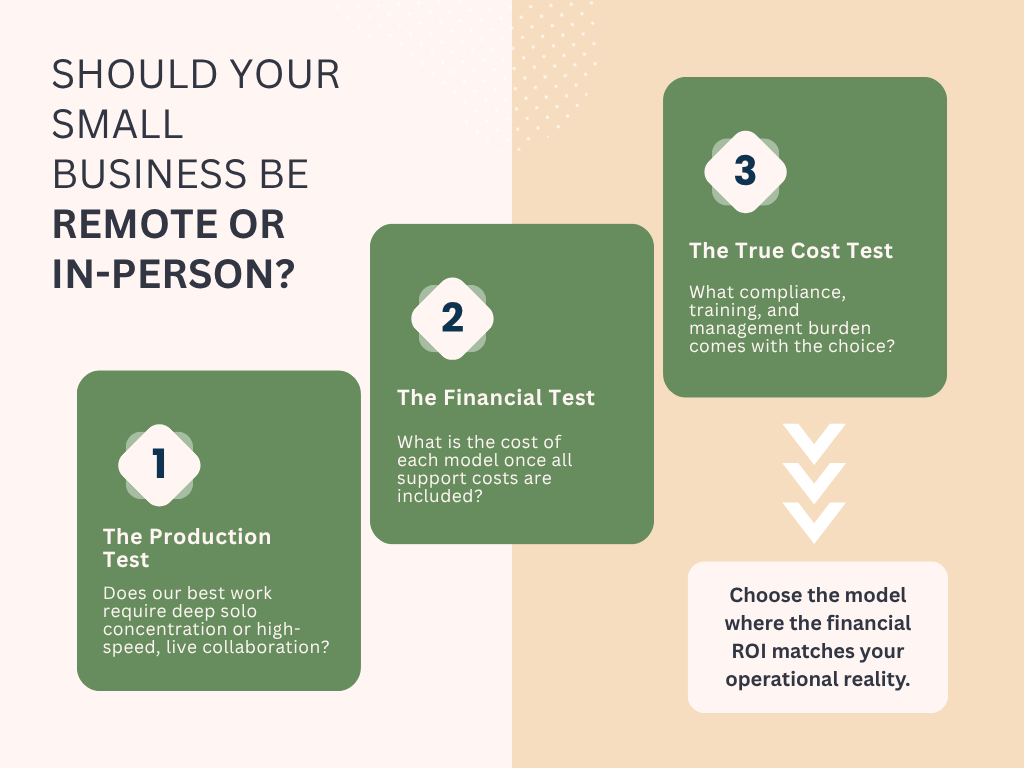
There’s no one right answer that applies to every business. The best model is the one that supports your employees’ well-being, boosts your business’s productivity, and gives you the best financial return on investment.
To determine the structure that is best for your small business, we must examine these three specific areas:
- How does your business produce its best work?
- What is the true cost of each model once all support costs are included?
- What compliance, training, and management burden comes with the choice?
Final thoughts
This is an area where you really need to know that your numbers back your decision.
So, if you’re considering a shift, let us run the numbers for you. We can help you think through the payroll, tax, culture, productivity, and cost implications so you can make the best decision for your business’s growth.
FAQs
“Is remote vs in-person work more cost-effective for small businesses?”
Remote work is generally more cost-effective due to the elimination of fixed overhead like rent, utilities, and office maintenance. However, businesses must factor in hidden costs such as remote security software (VPNs), home office stipends, and the increased administrative expense of managing multi-state payroll and tax compliance.
“How does hiring remote employees affect my business’s tax obligations?”
Hiring remote workers in different states typically creates tax nexus, requiring your business to register for payroll taxes, unemployment insurance, and workers’ compensation in those states. Failing to track an employee’s physical work location can lead to significant penalties and complex multi-state filing requirements.
“What are the main productivity differences between remote and office work?”
Remote work often boosts productivity for deep-focus tasks like coding, writing, or analysis by removing office interruptions. Conversely, in-person work excels at collaborative innovation, rapid problem-solving, and hands-on mentorship, as physical proximity allows for the informal learning that digital tools often struggle to replicate.
“Which business types benefit most from an in-person office setup?”
Businesses that rely on client-facing trust, high-pressure team coordination, or physical brand presence (like law firms, creative agencies, and luxury service providers) often see a higher ROI from in-person work. For these teams, the office acts as a tool for culture-building and professional development rather than just a workspace.
“How can a small business maintain company culture in a remote setup?”
Maintaining remote culture requires intentional documentation and structured communication. Since remote teams lack “watercooler” interactions, successful businesses use centralized knowledge management systems and scheduled virtual social check-ins to prevent standard drift and ensure all team members feel connected to the mission.
“What security risks should remote businesses prioritize?”
Remote businesses must prioritize endpoint security and access control, as data frequently moves through unsecured home Wi-Fi networks. Essential protections include Multi-Factor Authentication (MFA), professional-grade VPNs, and regular cybersecurity training to prevent phishing attacks that target the blurred boundaries of home-based workstations.